Idle Racer — Tap, Merge & Race
- 4.3
- Rating
- 10.00M
- Installs
- Free
- Price
 Analysis by App-foxy
I approached Idle Racer — Tap, Merge & Race expecting a lightweight racing game, but its appeal is less about long, technical races and more about the small decisions between them. You build cars, improve them, and keep the progress moving through short sessions. That makes it a very different proposition from a traditional racing simulator or a fully manual arcade racer.
After spending time with it, I see the game as a good match for players who enjoy gradual upgrades, simple controls, and the satisfaction of turning a basic vehicle into something more capable. It is published by CASUAL AZUR GAMES and sits in the racing category, although its idle structure is just as important as its driving theme. The best way to judge it is not by asking whether it feels like a console racer, but whether its loop fits the way you like to play on a phone.
What to consider before choosing it
The first decision is about control. If you want precise cornering, braking points, drifting lines, and a sense of mastering each track, this is probably not the right kind of racing game. Its focus is on building momentum through progression rather than demanding constant manual driving. I found that distinction important because the car theme can suggest a more traditional experience than the actual design provides.
You May Also Like

 Blood Strike: 2.5 Anniversary
Blood Strike’s Loadouts Turn Every Drop Into a Tactical Gamble
A close look at Blood Strike’s custom loadouts: how fast access to signature weapons reshapes its battle royale rhythm, rewards preparation, and narrows the gap between fights.

 Pandora - Music & Podcasts
Pandora’s Music Is Easy to Start, but Harder to Recover
Pandora’s strength is its low-effort path from a seed to a station. Its weak spot is how much confidence it asks you to place in connection, setup, and quiet recovery.

 8 Ball Pool
 Is Built on Rivalries, Rematches, and Routine
A close look at the rivalries, rematches, shared routines, and unanswered safety questions that turn a quick pool match into a persistent mobile community.

 Samsung Music
’s Quiet Strength Is Playing What You Already Own
Its reach comes less from spectacle than from dependable access to a personal library. That simplicity is both the app’s strongest retention engine and its ceiling.

 AccuWeather: Weather Radar
AccuWeather Review: A Quick, Clear Forecast for Everyday Decisions
For everyday plans, the best forecast is the one you can understand quickly. AccuWeather makes rain timing, radar, and local conditions easy to act on, with a few trade-offs.

 Hill Climb Racing
Why Hill Climb Racing Still Turns Crashes Into One More Run
A tiny car, a bumpy hill and one more upgrade: Hill Climb Racing keeps resurfacing because its simple chaos makes every near-miss feel personal.
More From Our News Desk



The second decision is about session length. This game works well when I have a few minutes to spare: I can check the current car, make an improvement, start another run, and leave. It does not require the same uninterrupted attention as a long race or a story-heavy game. That makes it suitable for commuting, waiting rooms, or a quick break, provided you enjoy repeating compact actions toward a larger upgrade goal.
The third decision is whether you like watching numbers and performance gradually improve. The satisfaction comes from making the next sensible improvement, not from discovering a completely different driving technique every time. I recommend thinking of it as a progression game wearing a racing jacket. The cars and speed provide the motivation, while the upgrade loop provides the structure.
It is free to download and aimed at Everyone, so it is easy to try without committing money at the start. The game includes in-app purchases priced at $2.99 per item. That does not automatically make the experience poor, but it is worth deciding early whether you are comfortable playing at the natural pace or whether purchase prompts will bother you. For me, the game is most enjoyable when I treat spending as optional rather than part of the basic plan.
How the core loop feels in everyday use
A realistic use case is a short evening break after work. I can open the game, review what the current car needs, improve it if I have enough resources, and begin another attempt without having to remember a complicated control scheme. If I am interrupted, the design is easier to put down than a competitive race that depends on staying focused until the finish.
That convenience is also the main trade-off. Because the sessions are built around repeated progress, the excitement can soften if I play for too long in one sitting. I get more from it when I alternate between active play and brief check-ins. In other words, it rewards a light routine better than a marathon session.
One useful habit is to pause before spending every available resource. I found it more satisfying to identify which improvement would help the next obstacle rather than upgrade automatically. This turns the game from simple tapping into a small planning exercise. The decision is not complicated, but it gives each visit a purpose and helps prevent the progression from feeling like a string of disconnected rewards.
Why its build-and-upgrade approach stands out
The strongest part of the experience is the feeling that the car is a project. Instead of treating every race as an isolated event, I think about how today’s improvement affects the next run. That creates a useful bridge between idle progression and racing: the vehicle is not merely selected from a menu, but something I gradually shape through repeated play.
This is where it wins against many conventional arcade racers. A manual racer may deliver more immediate excitement, but it can also demand more concentration and precision. Here, the reward is more forgiving. I can make progress even when I am not in the mood for a high-pressure challenge, and the game remains approachable when I only have one hand free or a short amount of time.
The game also benefits from a clear sense of direction. The goal is easy to understand: improve the car and become a stronger racer. I never needed a long explanation to know what I should be doing next. That clarity matters on mobile, where a complicated opening can be enough to make people close an app before they see its best qualities.
Another less obvious strength is how well the format supports experimentation with timing. Rather than tapping mindlessly from the first second, I can use a run to notice where progress slows, then adjust my upgrade priorities. This makes the game more interesting for players who enjoy optimizing a simple system. It is not deep simulation, but it does offer room for better choices.
Practical habits that make progression feel better
I recommend treating each session as a small test. Before upgrading, I look at what is holding the current car back and decide whether I want a broad improvement or a focused one. That approach is more useful than spending immediately because it connects the upgrade to a visible problem. Even in a casual game, a little intention makes the loop feel less automatic.
I also avoid judging a car after one disappointing run. Idle-style progression can make a vehicle feel underpowered until a few improvements accumulate. Giving the current build a fair chance helps me separate a temporary weakness from a genuine mismatch in play style. If I constantly switch direction, the progress feels scattered and the game loses some of its satisfying rhythm.
A third tip is to use the game as a background-friendly activity rather than expecting it to replace a full racing session. I get the most value from checking in during natural gaps in my day. When I want intense competition, I choose something else; when I want a low-friction way to keep improving a vehicle, this format makes more sense.
The current version is 0.9.275, and the game runs on devices using Android 6.0 or later. That makes it accessible to people who are not using the newest phone, although actual smoothness can still depend on the device. Before installing, I would check that the phone has enough free space and that the operating system meets the requirement, especially if it is an older handset.
Where a different racing game may fit better
Players who want realistic handling should look toward a dedicated simulation-style racer instead. Those games are better when the pleasure comes from learning braking, steering, acceleration, and track layout. I would not choose this title for a serious wheel-to-wheel competition experience because its main satisfaction comes from progression rather than detailed driving technique.
Traditional arcade racers may also be a better choice if you want constant action. They usually put the emphasis on immediate movement, quick reactions, and visual spectacle. This game is calmer and more incremental. It can feel rewarding in short bursts, but someone looking for a dramatic race every time may find the upgrade-focused rhythm too restrained.
There is also a difference between this and a deep car-collection game. If your priority is comparing many vehicles, tuning specific parts, or building a large garage with detailed customization, you should examine alternatives designed around those systems. Here, the appeal is the straightforward journey of improving the active experience, not the complexity of managing a realistic automotive collection.
That does not make the game inferior; it makes the choice more specific. I would recommend it to someone who likes the idea of cars but does not want to study settings or memorize controls. I would skip it for a player who sees racing games primarily as tests of reflexes. The same person can enjoy both types, but they satisfy different moods.
Free access, purchases, and the cost of changing games
The free entry point is useful because it lets you discover whether the idle racing structure suits you before paying anything. The important cost is not only money. It is also time: once I become invested in improving a car, switching to another game means leaving behind the progress rhythm I have built. That is why I suggest trying it during short sessions first, before making it part of a daily routine.
The $2.99 price per in-app item is simple enough to understand, but individual purchases can still add up if I use them repeatedly. My practical advice is to decide on a personal boundary before buying. If the game is enjoyable without purchases, keep it that way. If the pace feels frustrating unless I spend, that is a sign the game may not be the best fit for my expectations.
I also would not install it expecting a premium, one-time purchase experience. Its free-to-play structure is part of the decision. Some players are perfectly happy with optional purchases and gradual progress; others prefer to pay once and remove the question entirely. For the second group, a paid racing game may be a better match even if its initial price is higher, because the spending model feels more predictable.
The game has reached over ten million installs and holds a 4.4 average from around thirty-one thousand ratings, with roughly nine hundred fifty reviews. Those figures suggest that the format has found a substantial audience, but popularity should not decide the purchase on its own. The real question is whether you enjoy incremental car development more than direct racing control.
Who should install it, and who should skip it
I think it is a strong choice for casual players who want a racing-themed game that can be opened and closed easily. It also suits people who enjoy upgrading a project over time, players with older compatible Android devices, and anyone who prefers a gentler alternative to competitive racing. The Everyone age rating makes it a straightforward option for a broad audience, though individual tolerance for purchase prompts and repetition still matters.
I would be cautious about recommending it to someone who needs deep content from every session. If you want a campaign with dramatic events, a detailed physics model, or demanding online competition, the simple structure may feel limited. It is also not ideal if repeated upgrade decisions quickly become boring for you. The game depends on the pleasure of gradual improvement, so that preference is more important than the racing label.
For iPhone and Android users comparing downloads, the decision should focus on the kind of racing experience wanted rather than on the platform alone. On a compatible Android device, the minimum requirement is Android 6.0. The game is free to start, so the most sensible approach is to test the first sessions without buying anything and observe whether the loop remains enjoyable after the initial novelty fades.
My recommendation after weighing the trade-offs
Idle Racer — Tap, Merge & Race is best understood as a casual upgrade game with racing at its center, not as a substitute for a full driving simulator. I like its low-friction sessions, clear goal, and the way each improvement gives the car a sense of ongoing development. It is easy to recommend to a friend who wants something approachable for spare moments and enjoys watching a vehicle become more capable.
My recommendation becomes more qualified for experienced racing fans. If you need precise steering, complex tuning, or a strong feeling of direct competition, choose a different category of game. This one wins when convenience and progression matter more than technical driving. It loses when the player expects every race to be a test of skill behind the wheel.
CASUAL AZUR GAMES has built an accessible mobile racer for people who enjoy small decisions and steady advancement. I would install it for short daily breaks, keep purchases optional, and focus on purposeful upgrades rather than tapping without a plan. With that mindset, it offers a pleasant, easygoing way to enjoy car progression. Without that mindset, its repeated loop may feel too light. For the right player, though, that simplicity is exactly the point.
FAQs for Idle Racer — Tap, Merge & Race
01What is the main objective of Idle Racer — Tap, Merge & Race?
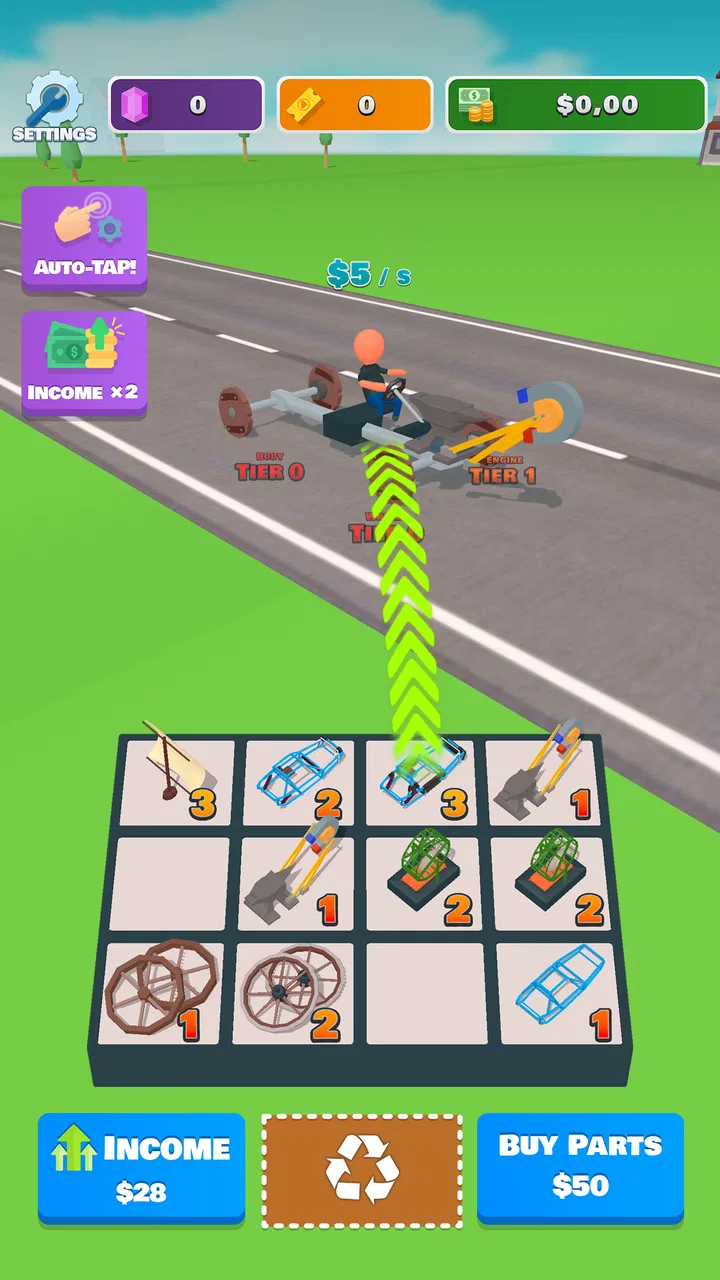
Idle Racer is a casual racing game where the primary goal is to build and upgrade your fleet of cars. Players can tap to speed up the races, merge cars to unlock new models, and strategically manage resources to maximize earnings and progress through various racing challenges.
02How does merging cars work in Idle Racer?
Merging cars is a core mechanic in Idle Racer. Players can combine two identical cars to create a more advanced and faster vehicle. This merging process not only enhances your fleet but also boosts your in-game earnings and helps you progress through levels more efficiently.
03Is an internet connection required to play Idle Racer?
While Idle Racer can be played offline, certain features, like in-game purchases and competitive leaderboards, require an internet connection. Playing online also allows you to receive updates and participate in special events, providing a more enriched gaming experience.
04Are there in-app purchases in Idle Racer?
Yes, Idle Racer offers in-app purchases. Players can buy various packages to accelerate their progress, such as additional coins, special cars, and other power-ups. However, the game is designed to be enjoyable without spending money, with plenty of opportunities to earn rewards through gameplay.
05What age group is Idle Racer suitable for?
Idle Racer is suitable for players aged 3 and above, making it a family-friendly game. Its simple mechanics and colorful graphics appeal to a wide audience, including both casual gamers and racing enthusiasts. Parental guidance is advised for in-app purchases to prevent unauthorized transactions.
Pros
- Simple and intuitive gameplay mechanics.
- Variety of cars to unlock and upgrade.
- Offline play mode available.
- Minimal in-app purchases required.
- Frequent updates with new features.
Cons
- Repetitive gameplay can become monotonous.
- Limited customization options for cars.
- Advertisements can be intrusive at times.
- Graphics are basic and not very detailed.
- Requires a stable internet connection for some features.

Idle Racer — Tap, Merge & Race
Gallery